


Spotlight Priest: Gregory MacLellan
Born in St. George’s in 1876, he received his early education in the local school and worked awhile on the farm. After three years at St. Dunstan’s College he enrolled for theology at the Grand Seminary of Quebec where he spent four years and merited a doctorate in theology.
In 1903 he was ordained to the priesthood in Quebec for service in our diocese. He began his priestly ministry as professor at St. Dunstan’s College where he served for three years. In 1906 he was named assistant at the cathedral parish and the following year was appointed cathedral rector.
That was the year when the magnificent cathedral was shiny new, having been officially opened just that year with great splendour after ten years of construction. Six short years later, however, this immense cathedral was no more, having caught fire and burned to the ground in the early morning of March 8, 1913. It was a tremendous shock to all, but the faith and courage of many people, like rector MacLellan himself, stood tall.
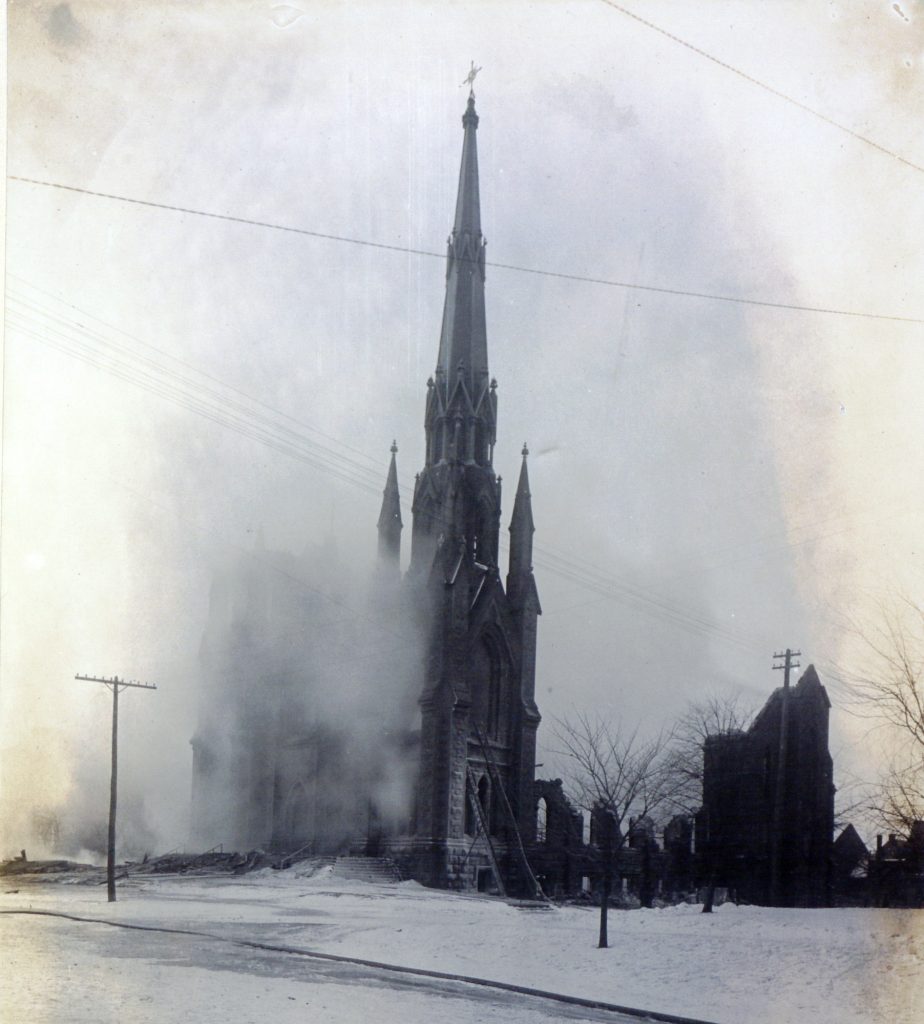
Immediately the general plans for construction of another cathedral were being formed. Just a month after the massive fire, the parish was fortunately able to purchase the recently-vacated Zion Presbyterian Church just around the corner on Richmond Street (site of today’s Murphy’s Community Centre). This served as pro-cathedral for awhile and it was there that our new and young Bishop Henry O’Leary was installed scarcely three months after the fire.
In 1915 Father MacLellan was transferred to the rectorship of St. Dunstan’s College, a position he filled with much stability for eight years. It was a time of expansion for the college and during his rectorship it was raised to the status of a university in 1917.
MacLellan was named pastor at Tignish in 1923 and held that position until 1931 when he was appointed pastor of the expanding parish of Summerside. In 1933 Father MacLellan was named Vicar General of our diocese under Bishop O’Sullivan and held that position also under all the years of Bishop Boyle and into the early years of Bishop MacEachern until 1958, a total of 25 years in all.
In between bishops he also served as diocesan administrator and in 1933 he was named a monsignor. Declining health in 1958 led to his retirement from the Summerside pastorate and he lived his last six years as a patient/resident at the Charlottetown Hospital, where he died on January 27, 1964.
His funeral Mass was celebrated in his native parish at St. George’s by Bishop MacEachern in a full church, including over 40 priests. Burial was in the parish cemetery within the priests’ section there.
The MacLellan priesthood was indeed a full one, well-rounded and lived. He was the only priest here who held the cluster of posts which included professor, parish assistant, cathedral rector, university rector, pastor, Vicar General under three bishops and as diocesan administrator twice. Well done, good and faithful servant, like the Gregorys in the Church’s past.
Tragedy over Vernon River
It was all about a large family reunion in early summer, brought on by the upcoming marriage of one of the many daughters.
John Joe Walsh (1869-1936) and his wife Emma McCarthy (1871-1942) lived on a splendid farmstead at Elliotvale in Vernon River Parish and were the parents of fifteen living children. Genevieve, a local school teacher, was to be married to Leo Morrissey of Iona on Wednesday, June 27, 1928.
Two brothers and a sister, arriving from New York by the evening train, were greeted at the station in Charlottetown by a brother and two sisters. A brother Joe, a seminarian, was to spend the night in town while the other five, after errands and visiting, headed for home at Elliotvale in a 1924 Paige open-back car driven by one of the brothers.
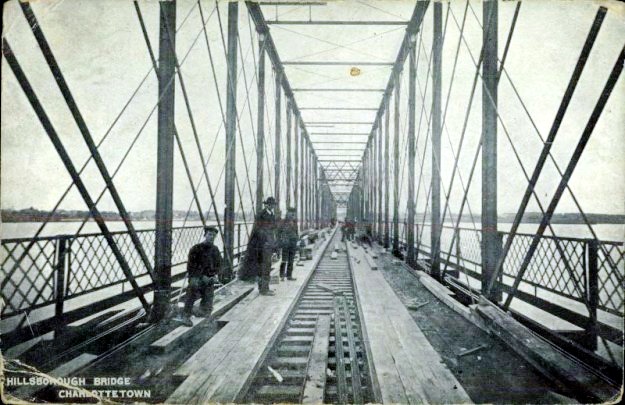
The night was foggy. Having crossed the old iron Hillsborough Bridge and then down a poor road briefly, the driver at slow speed took a wrong turn to the right which led straight to the Southport wharf. The car simply bounced over the minimal plank barrier and dumped the vehicle and all five occupants into the Hillsborough River.
Two were barely able to cling to the wharf structure and their cries for help were answered by a dredge crew from the Charlottetown side. The remaining three unfortunately drowned and their bodies were recovered the next day.
The dead were Genevieve, the bride-to-be, Blanche, her maid of honour, and Arthur. Survivors were George and Irene.
Next day the jury condemned the Department of Public Works for not having a proper safety barrier at the wharf which would have prevented this tragedy. Two others had been drowned at that spot in the same way a couple of years earlier.
On June 29, 1928, a solemn funeral Mass was held instead at St. Joachim’s Church, following the wake of the three deceased in the parlour of the old home in Elliotvale.
Father Peter McGuigan, the pastor, was celebrant. Among the remaining twelve family members, most of them continued to live on P.E.I., an upright and friendly people, close to the land. Three of the daughters became valued members of the Sisters of St. Martha of PEI while Joe, mentioned earlier as a seminarian in 1928, was ordained to the priesthood in Vernon River in 1931 for service in the Archdiocese of Regina.
Having been pastor in three parishes, he died in 1952 at the age of 49. Waked at the old home in Elliotvale, his funeral Mass was celebrated at Vernon River by Bishop Boyle in the presence of a full church, including over 40 priests. Father Richard Ellsworth, a SDU classmate, preached.
Father O’Shea’s cathedral memories
Another of my pleasant memories of the Sunday High Masses at the cathedral in the 1950s and later was the sweet sound of the gallery organ. This smallish instrument came over from the old Presbyterian church around the corner on Richmond Street which the parish purchased in 1913 right after the new majestic cathedral burned to the ground that year.
Bessie (Blanchard) Dougan was the long-time organist who made that modest organ sound so lovely with lots of boom when needed, especially with the male choir on Sundays. Before the High Mass Bessie would always play a soft piece, so prayerfully, for five minutes or so to provide a peaceful setting for what was to come. She would also faithfully assist the presiding priest with his sung parts by softly intoning for him the first line of the Preface dialogue, the introduction to the Lord’s Prayer (Pater Noster) and likewise to the tricky Ite Missa Est at the conclusion of the Mass.
Bessie was a tiny woman who came from a highly musical Blanchard family who lived but a Sabbath walk from the cathedral. She must have been its organist for 60 years, retiring around the time of Vatican II. Bessie died in 1989, aged 98. Do not be afraid, daughter, for all the assembly of my people know that you were a woman of great worth. (Ruth 3,11).
Clergy Quiz: Who was the only altar boy at our cathedral who became a bishop? Jennifer awaits your answer.
I am the Good Shepherd, says the Lord. I know my sheep and my own know me. Alleluia.
Father O’Shea’s Diocesan Reflections May 7, 2019 # 40