


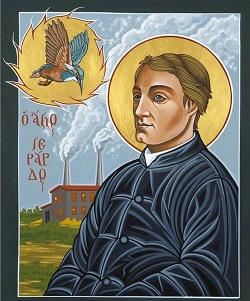
Gerard Manley Hopkins is regarded as one the Victorian era’s greatest poets. His fame came posthumously.
Raised in a prosperous and artistic Church of England family, Hopkins first read John Henry Newman’s Apologia pro via sua, at Balliol College, Oxford in 1862 – a document which discussed the author’s reasons for converting to Catholicism. Two years later, Newman himself received Hopkins into the Roman Catholic Church. Hopkins soon decided to become a priest himself, and in 1867 he entered a Jesuit novitiate near London.
He became deeply influenced by 13th century Franciscan philosopher-theologian John Duns Scotus (1266-1308), whose doctrine of ‘thisness’ – haecceity – is derived from haec, the Latin word for “this.”
God, according to Scotus, is continuously choosing each created thing specifically to exist, moment by moment.
The direct implication of this truth is that love must precede all true knowledge, which was at the heart of all Franciscan-based philosophy.
Hopkins revolutionary poetry is infused by this belief.
Watch a terrific 1986 BBC documentary on the life and poetry of Gerard Manley Hopkins at: www.newpilgrimpath.ie.