


Father O’Shea’s Diocesan Reflections October 2022
Away back in 1893, PE Islander Francis Kelly of Vernon River and the cathedral parishes was ordained to the priesthood in the seminary chapel at Nicolet, Quebec for the Diocese of Detroit.
Soon he was named pastor at Lapeer, Michigan which had two missions. In great need of money, especially for a new parish church, he took part in the well-established “speakers’ bureau”, a powerful outreach of adult education in its day through which many excellent speakers participated along the way, choosing their own topics. Father Kelly, always using Catholic teachings, took part in this new evangelization for a few months annually over seven years.
A fine speaker, he raised sizable money from this for his new church. While generally enjoying this missionary outreach, he experienced much hardship along the way, for example: missed trains, long wagon rides through mud and rough roads, hotels of horror, shady meeting rooms, boys throwing peanut shells and popcorn in the front rows, old ladies who looked with disapproval at the first Catholic priest they had ever seen, blizzards in the Dakotas, snow and stalled trains in the Adirondacks, catching colds and still keeping at work.
However, in these missionary journeys, like St. Paul, he saw the country as no other priest there had seen it. His territory covered much of the nation, showing him firsthand the sad conditions of vast areas without Catholic churches or leadership. Eventually, speaking to his bishop about this neglected state of the church, he suggested that something needed to be done about it. At once, the bishop pointed his finger at Kelly and said “You do something about it.”
Shocked at first but then pleased that a door was finally being opened for this new vision, by 1905 the Catholic Church Extension Society of the United States was established with him as president. For the first two years its headquarters were in his parish at Lapeer but then they relocated to Chicago where they remain to this day. Extension’s main objectives were to assist in the building of churches in needy areas, to support priests in poverty- stricken areas, to finance seminarians, to help preserve the faith of Jesus Christ among scattered Catholics and much more.
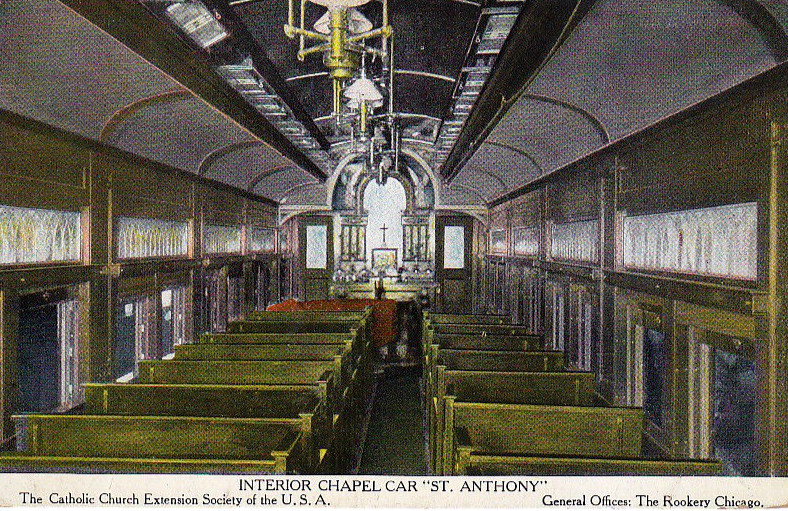
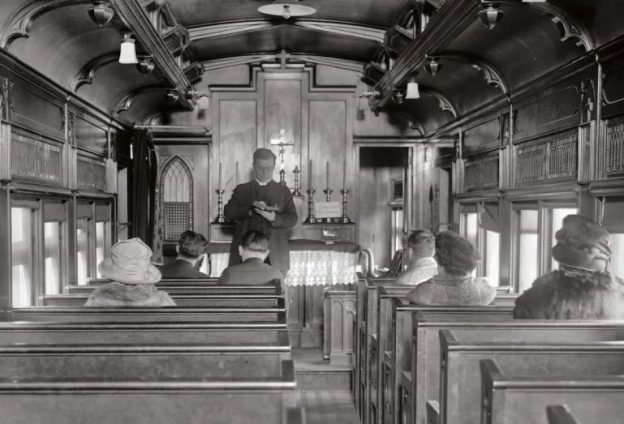
One of the Society’s ways of reaching isolated areas and people was by use of “chapel cars” attached to trains across the land, a new and quite exciting idea for all involved. The first chapel car appeared in 1907, named St. Anthony, seating for 60 with sleeping quarters for the chaplain and other needy spaces, a temporary place of worship in distant lands, especially the Southwest and Pacific Northwest. At each railroad stop there would be Sunday Mass and evening devotions. Each morning had Mass, then later services like rosary, sermon and question box. The chapel car kept moving usually after a month at each place. In those chapels children were baptized, the fallen-aways reconciled, short missions given, literature distributed and incoming financial offerings gratefully received. The “church on wheels,” pulled by a steam-engine train into a village, became a great attraction to Catholics and others alike .
This was 20th century missionary outreach by preaching, assisting converts, defending the faith, speaking God’s word across the land where at the time no churches existed. It was also a great ecumenical adventure with no condemnations, just preaching the faith of the Church and dealing kindly with questions or challenges raised. Quite often it was only non-Catholics who were present, many of them donating land and money for new churches.
In 1912 the old St. Anthony car was replaced by two very updated ones, fittingly named St. Peter and St. Paul. By 1923 the era of the chapel car ended, partly due to more stringent railway discipline but also to great advances in the whole missionary outreach by that time. In any case the chapel-car mission brought to a close one of the most interesting chapters in the history of the Catholic Church Extension Society during its pioneer days across its vast mission field.
Before leaving this short account of that phase of the USA Church Extension, we want to mention three Prince Edward Islanders who played such exceptional roles within it. First, of course, was Father Francis Kelly, its real founder while in Lapeer and early driving force from Chicago. In 1924 he was named Bishop of Oklahoma where he remained until his death there in 1948 at age 77. He was also the author of numerous books and a frequent visitor back home to PEI over the years.
A tremendously prominent lay man in Extension’s pioneer years across the USA was George Hennessey from Charlottetown, a first cousin of Father Kelly. While working within the local railway system here he was invited to go west and join the excitement of Church Extension from its very beginning and was put in charge of the chapel-car outreach. George, familiarly known as a genial redhead, became one of the most fascinating characters in the history of the Extension Society. In the chapel car, along with being its superintendent, he served as altar boy, janitor, organist and much more in this missionary church on wheels. He was a natural for this role, brimful of personality, a splendid speaker, fine singer, a real magnet in drawing Catholics and others to this unique missionary venture. By 1923 this chapel-car period of Church Extension came to its end and George then moved west to Portland, Oregon where he soon established a funeral-home business. In 1925 he was invested with the Knighthood of the Holy Sepulchre in St Mary’s Cathedral there, only one of three others in the United States at that time to have received this honor. Possessed of that splendid baritone voice and much musical ability, he was choir director at St. Patrick’s Church in Portland for his years there. George died in a Portland hospital, following surgery, on February 23, 1933 at age 55. His funeral Mass in the Portland Cathedral, celebrated by Archbishop Howard, was an immense gathering of people from all walks of life. His remains were transferred to Charlottetown for burial in the Catholic cemetery here.
Another splendid Islander, deeply involved in that Catholic Church Extension in the USA, was Father Richard St. John from Souris. He was ordained for Charlottetown in 1919 and served as cathedral curate here for five years until struck down with tuberculosis. He went to Chicago for treatment and before long met our well-known Father Kelly, head of the Extension Society whose offices were located there. Later that year of 1924, Kelly was named Bishop of Oklahoma and brought Father Richard with him as his secretary and for other duties as health permitted. In 1928 Father St. John returned to Chicago’s Extension offices where he served capably and in 1940 he was appointed vice-president of the Society, a position he held until his sudden death at his bedside on February 17, 1954, having died while saying his night prayers. In Chicago, Monsignor St. John was regarded as one of the most outstanding priests in the history of Extension through his unassuming disposition and kindness of heart. Requiem Mass was celebrated for him in Chicago’s Holy Name Cathedral by Cardinal Stritch and then in St. Dunstan’s Basilica, Charlottetown, by Bishop Boyle. Burial took place in Souris.
Very well done good and faithful missionaries all.