


Greetings from the western tip of the Island!
I am pleased to say that my Internship experience here at Saint Simon and Saint Jude in Tignish has been a challenging experience that has produced a lot of growth and self-awareness in myself since I started back on September 1st. The people here are most welcoming and glad to help out a young seminarian as he journeys with them and learns the ropes of being a parish priest. I want to thank you all for your prayers for me, but also for your prayers for more vocations to the priesthood and our clergy on the Island.
Following is a short reflection I am submitting to the seminary as part of my program, but I wanted to share it with all of you as well. Please continue to pray for me as I continue this great adventure in this “weak” part of the Island. — Walter Flynn
For Whom the Bells Toll
Listen, listen to the thunder of his voice and the rumbling that comes from his mouth. Under the whole heaven he lets it loose, and his lightning to the corners of the earth. After it his voice roars; he thunders with his majestic voice and he does not restrain the lightnings when his voice is heard. God thunders wondrously with his voice; he does great things that we cannot comprehend. For to the snow he says, ‘Fall on the earth’; and the shower of rain, his heavy shower of rain, serves as a sign on everyone’s hand, so that all whom he has made may know it.
Then the animals go into their lairs and remain in their dens. From its chamber comes the whirlwind, and cold from the scattering winds. By the breath of God ice is given, and the broad waters are frozen fast. He loads the thick cloud with moisture; the clouds scatter his lightning.
They turn round and round by his guidance, to accomplish all that he commands them on the face of the habitable world. Whether for correction, or for his land, or for love, he causes it to happen.
— Job 37: 2-13
I honestly never thought that I would hear with my actual ears the voice of God spreading throughout the world. I am accustomed to hearing Him in my heart (when I choose to listen). There in the silence, He can speak volumes; there is less chance, some days, for it to be lost amongst the tumult and noise the world itself produces.
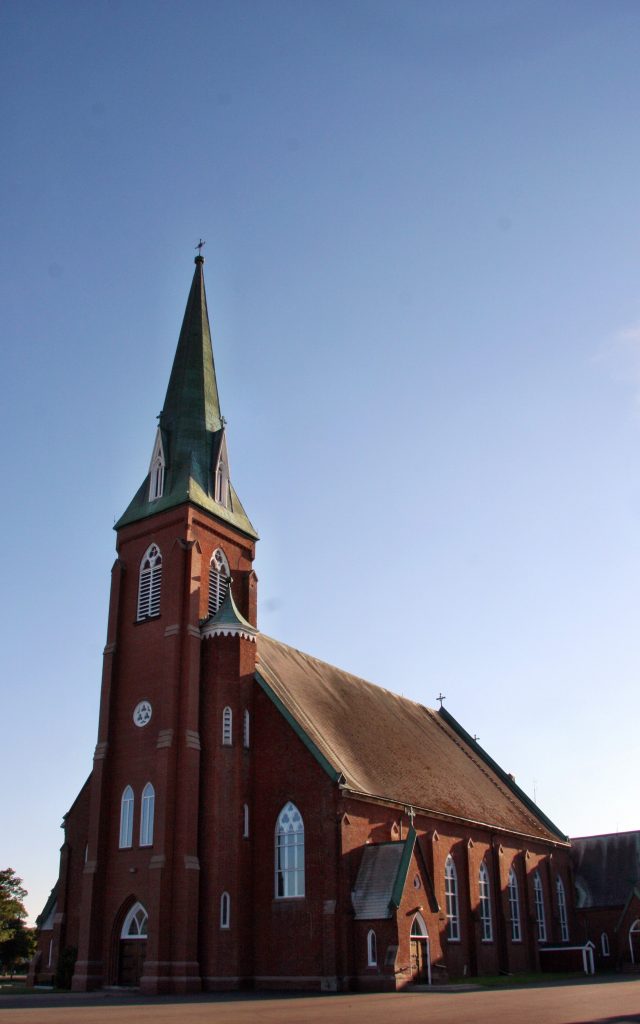
St. Simon & St. Jude Church, Tignish, PEI
Saint Simon and Saint Jude Church was always, and remains today, the largest structure in the area. Far away from the city — with the city’s taller structures — St. Simon & Jude’s bell tower is visible for miles around. And situated at the top of a hill, she is in a perfect place for her bells to ring out across the land. In fact, I would not be surprised if they were heard by you all in Toronto, or even as far away as Saint Catharines.
Our parish continues the long tradition of ringing the Church bells several minutes before Mass, harkening back to the ancient tradition that summoned people to the Church before the time of wristwatches and satellite-controlled time keepers. Our parish also maintains the tradition of the defunctos ploro (“the passing bell”) — the death knell that is rung when a member of the community dies. In the month of September alone, the defunctos ploro knelled ten times.
The passage from Job we read speaks of the voice of God thundering throughout the land and the effects it has on it. I can tell you from experience here at St. Simon and Jude that sometimes that voice comes in the form of a bell. In ancient times, prophets extolled their listeners to “make a joyful noise to the Lord, all the earth (Psalm 98:4)”. High Priests wore bells on their garments to ring when they entered and exited the Holy of Holies (Exodus 28: 33-35). Churches and monasteries were built close to bells in early Christianity times because the bells were important time keepers. By the 8th-century, bells were either right next to a church or they were installed in the church. Bells in a church belfry intend to summon, celebrate, remind and commemorate[1].
Church bells are still particularly important in small communities such as Tignish. In a community where there is a strong attachment to the church, perhaps it does not seem to be as necessary. After all, we all have accurate watches and timekeepers to tell us when it is time to go to Mass. But they still cause us to pause. The defunctos ploro in particular causes us to pause when its knell reaches our ears. Some people listen attentively to the number of knells (nine for a man and six for a woman), pausing to reflect and pray for the soul of the person who has died, even if they are as yet unaware of exactly who died. It can be as effective as a bulletin announcement.
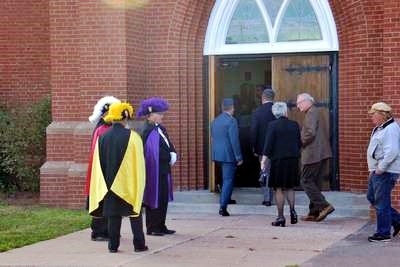
Gathering for a funeral Mass in Tignish.
As I previously mentioned, the death knell rang out ten times during the month of September alone. September was a very difficult month in this parish, as we had an unusual string of deaths, including the tragedy in which a fishing boat capsized with the loss of two of the three men on board. It was difficult to hear the passing bell so much; I knew that many of the people of the community had not recovered from the previous death and they seemed to be piling on top of each other, compounding grief, and yes, spiritual burden on the parish staff. As Job mentioned in this passage, God’s voice, through the peal of bells, rings throughout this land, in this case not for correction or the land, but rather to give us pause and remind us of the role faith and the Church has in our lives.
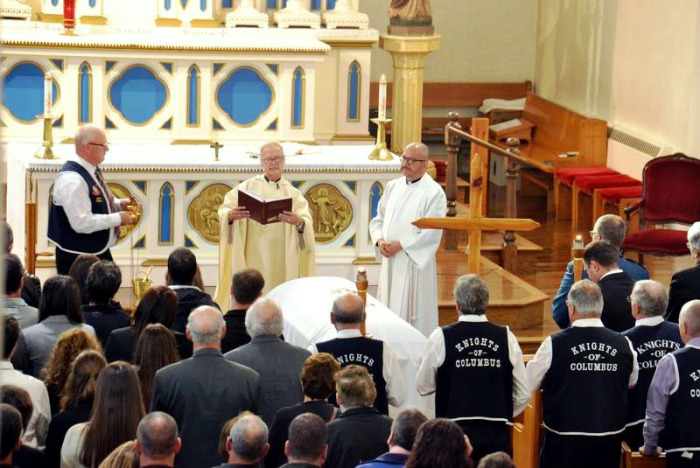
The prayers of commendation
In this world of instant communication topped off with rapid word of mouth (i.e., gossip), do we really need church bells anymore? Have they become obsolete? We should ask the families of the recently deceased who phone the Parish Office to ensure that Talbot, our custodian, is going to go over to the Church to ring the bells. Or maybe we can ask the handful of people who, upon hearing the death knell, phone the Parish Office to find out who has died. Sometimes at the funeral service tears are not shed until the casket arrives at the back door after the Mass has been celebrated and the slow, steady knell of the bells begins. Maybe this only means we are a sentimental creature; the bells stir in us tender emotion, more refined feelings we usually put on hold. Even if this is the case, if they are a throwback to a bygone era, I would never want to take the bells out of Saint Simon and Jude.
Whatever they do, they do cause us to pause and they can stir heavy emotions and bring back memories. After hearing the defunctos ploro, you kind of hope that it never happens again, especially one particularly heavy week in which we heard it four times.
The voice of God is indeed powerful as Job indicates. But power does not always mean volume. Sometimes the voice of God is in the silence of our hearts, other times it peals loudly across the land from the Church bells, and at other times, it is in the passionate homily delivered by a simple country priest. Wherever it is coming from, we need to be attentive to what it is trying to say to us. We need to pause and reflect on the importance of our faith and the Church, but also the little traditions that go along with it. We need to not be afraid of the sentiment and emotion God can withdraw from us as we listen to His voice; instead, we need to be ready to take appropriate action, to live out the faith we profess if that is what is required. Or maybe we simply need to bask in the voice, to remind ourselves that despite our weakness and faultiness, we are always in the presence of God, and His Church is never too far away either.
May Saint Simon and Saint Jude pray for us.
[1] Wagner, Angela. The Significance of the Number of Rings From A Church Bell. Accessed October 25, 2018 from https://classroom.synonym.com/the-significance-of-the-number-of-rings-from-a-church-bell-12080898.html